Comparison of end2end and non-end2end multimodal systems for Document understanding tasks
Team Members
- Gowtham Ramesh (gramesh4[at]wisc.edu)
- Sai Nikhilesh (krishnamurt6[at]wisc.edu)
Important Links:
- Comparison of end2end and non-end2end multimodal systems for Document understanding tasks
- Introduction
- Problem Statement
- Datasets and Evaluation
- Models
- Results
Introduction
The field of multi-modal deep learning [2,3,10] is rapidly developing, with the goal of creating models that can process and understand data from multiple sources like text, images, and audio. The integration of different modalities, such as text, images, and audio, is becoming increasingly important in areas such as natural language processing, computer vision, and robotics. In this project, we aim to compare the embeddings of end-to-end multi-modal systems, which incorporate both CNN and transformer networks [9] trained together, with non-end-to-end systems that process individual modalities for tasks involving text-rich images such as receipts/visiting cards and PDF documents.
Problem Statement
In this project, we plan to compare the end2end and non-end2end multimodel systems for Document understanding tasks where the primary focus lies on
- what is the qualitative and quantitative quality of the embeddings generated by end to end multimodel systems as compared to non-end-to-end approaches
- How do the two approaches compare in terms of the amount of text present in the images, considering low-text content scenarios such as visiting cards and high-text content scenarios like documents?
- How do the two approaches perform in scenarios with limited data resources, such as low-resource settings, compared to high-resource settings for fine-tuning?
By answering the questions posed in this project, we can better understand the effectiveness and efficiency of end-to-end approaches compared to non-end-to-end approaches for processing such datasets. Additionally, it is an interesting research question to explore the benefits of end-to-end approaches, as they are generally more challenging to train than non-end-to-endcounterparts. Overall, this project has practical implications for industry and academic researchers in developing better multi-modal deep learning models for text-rich datasets.
Datasets and Evaluation
Stanford Visual search dataset[2]: Though this dataset was created for visual image search. Some of the subsets, like book covers, business cards, and DVD covers, have images that have text. We plan to use the business cards dataset so that we can also test the models on entity extraction + detection. In total, we have 480 images with each image containing up to 8 fields - name, phone, address, fax, website, email, designation and company.
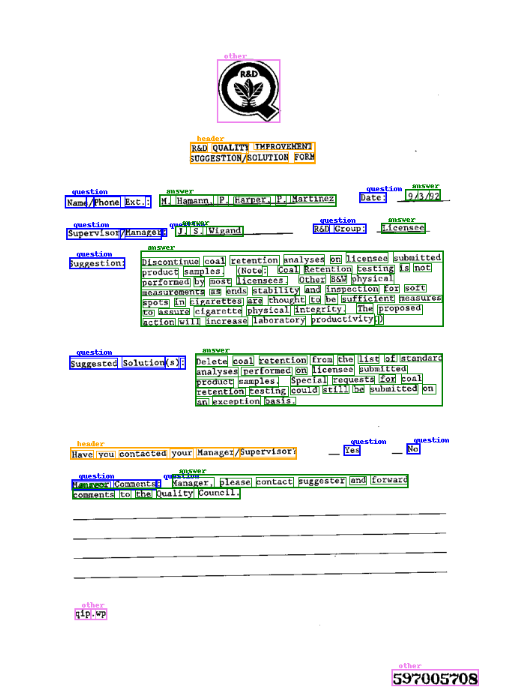
FUNSD[4]: The FUNSD dataset is a collection of annotated forms in various formats, including scanned PDFs and images, designed for form understanding tasks such as layout analysis, information extraction, and field identification. The dataset contains 199 real, fully annotated, scanned forms, as shown in figure below.
RVL-CDIP dataset[7]: Unlike the other three datasets, which focus on entity extraction, this dataset contains images of emails, documents, invoices, scientific text, etc, and we intend to use this for quanlititative check of image embeddings for document classification. Specifically, It consists of 400,000 grayscale images in 16 classes, with 25,000 images per class. To make training on a small scale, we only train on 50K images across 10 classes preserving the class distribution.
In summary, we plan to use 3 datasets - one with less text, one with denser text for entity recognition and a dataset for document classification/ clustering.
Models
End2EndModel - LayoutLM (Deep Learning Model)
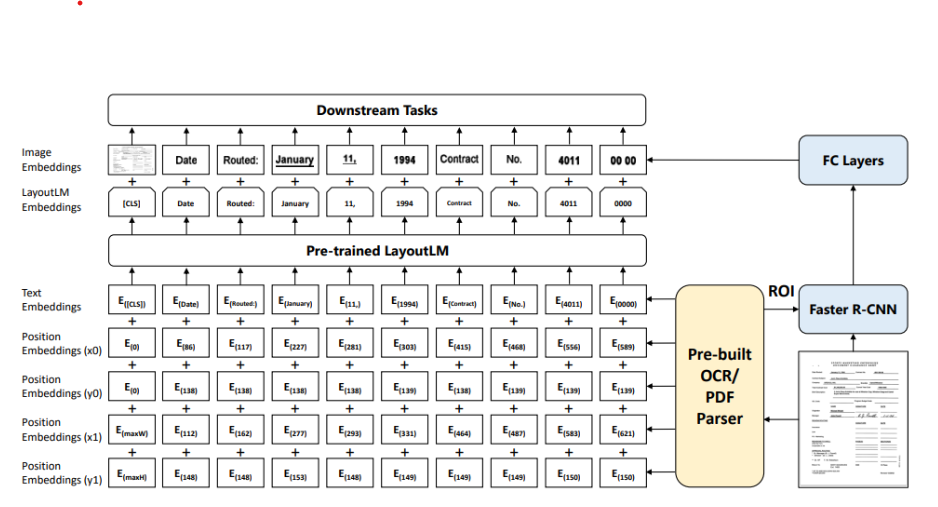
LayoutLM[11] is a multimodal Transformer model which is used to perform document processing. It is a pre-training model that incorporates both text and layout information for document image understanding. The authors demonstrate that LayoutLM achieves state-of-the-art performance on several image- text downstream tasks by jointly pre-training on text and layout tasks. LayoutLM is built on top of the widely used BERT architecture and extends it to incorporate layout information by adding an additional layout embedding layer. We plan to use LayoutLM as our end to end model for this project.
Non End2EndModel - CTPN
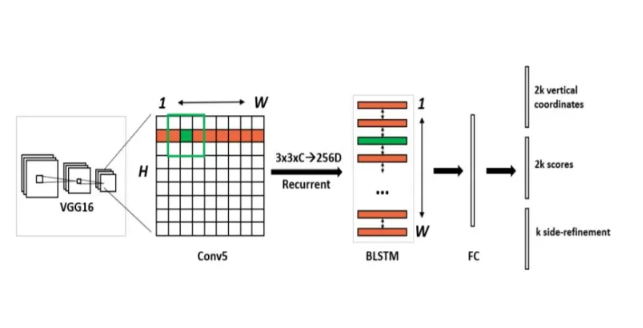
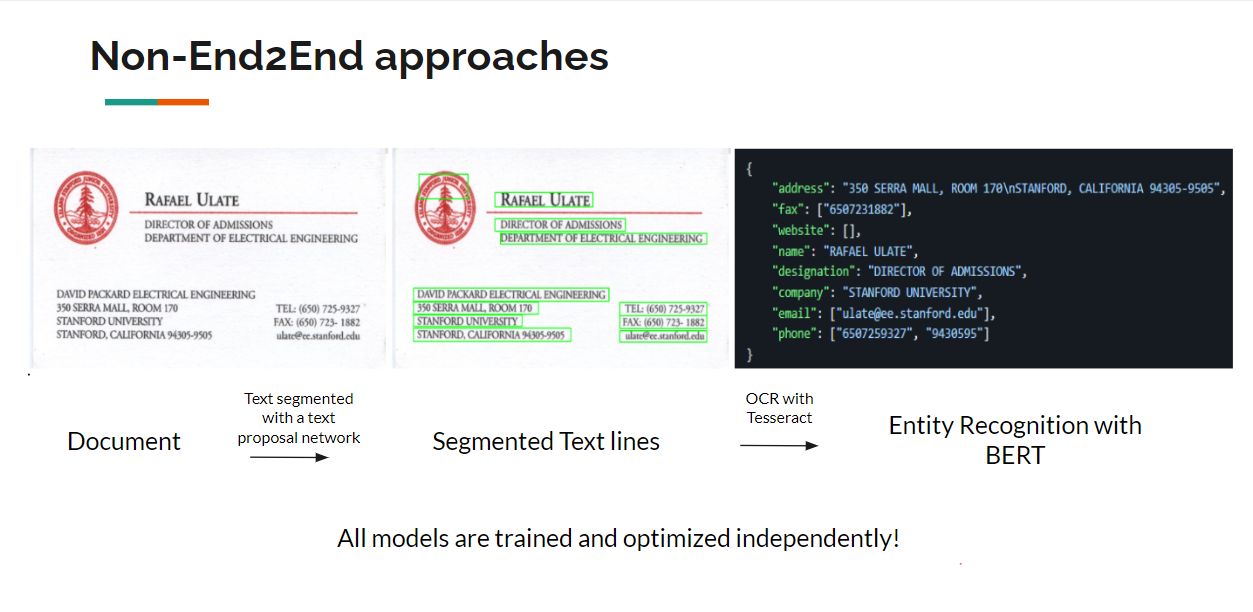
CTPN[8] refers to Connectionist Text Proposal Network. This name was given to this model because it detects text lines in sequence of text proposals. It uses a pre-trained VGG16 model to extract features from the image and then uses a recurrent neural network to generate text proposals. The proposals are then scored and refined; the final text boxes are output. The CTPN has several advantages over previous methods for detecting text in natural images. First, it is able to detect text in a wider range of conditions, including low-light and cluttered images. Second, it is able to detect text of different sizes and fonts. Third, it is able to detect text in multiple languages. We will use CTPN as the visual model for the non-end-to-end variant to extract text proposals. These text proposals would then be fed to OCR systems for text and LSTM/transformer-based networks for entity recognition. All these systems would be optimized separately.
BERT (Natural Language Processing Model)
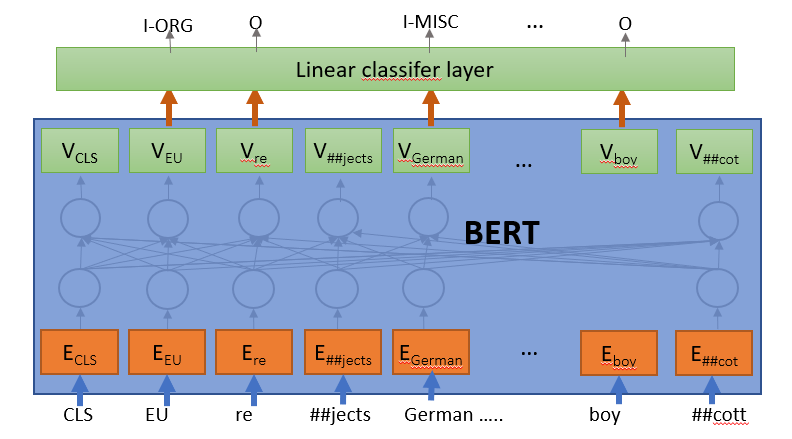
BERT[1] refers to Bidirectional Encoder Representations from Transformers. This is a language representation model that can be used for a wide range of natural language processing tasks. It is pre-trained on a massive dataset of unlabeled text with the masked language model objective, and can be fine-tuned with just one additional output layer to create state-of-the-art models for a wide range of tasks. We plan to adapt BERT or a variant of BERT to do entity recognition on top of OCRed output.
Non-end2end model workflow
Results
Results on FUNSD dataset
Based on the F1 scores shown in the table 1, we can see that the end-to-end system (LayoutLM) outperformed the non-end-to-end system on all four classes of the FUNSD dataset as well as the overall F1 score.
Comparison of F1 scores on FUNSD dataset by class
| Class | Non-end-to-end | End-to-end (layoutLM) | |
|---|---|---|---|
| Question | 0.79 | 0.91 | |
| Answer | 0.51 | 0.70 | |
| Header | 0.89 | 0.94 | |
| Other | 0.67 | 0.83 | |
| Overall | 0.71 | 0.845 |
Observations:
The largest improvements were observed in the ”Answer” and ”Other” classes. In fact this the class that was confused most by the BERT model leading to poorer results for non-end to end system, while the end2end system uses the conventional question that follows the answer from the image to get better accuracy.
Labelling Stanford visual search
Though this dataset is intended for visual search, but we repurpose this dataset to do entity recognition as it is a good benchmark to test images less text (compared to PDF images which are dense in text). Since we dont have the entity labels, we create pseudolabels with GPT-3[6] api. A manual check of 25 images entity labels shows that we get 100% accurate entities except for Fax vs phone. Hence we skip both these classes for evaluation.
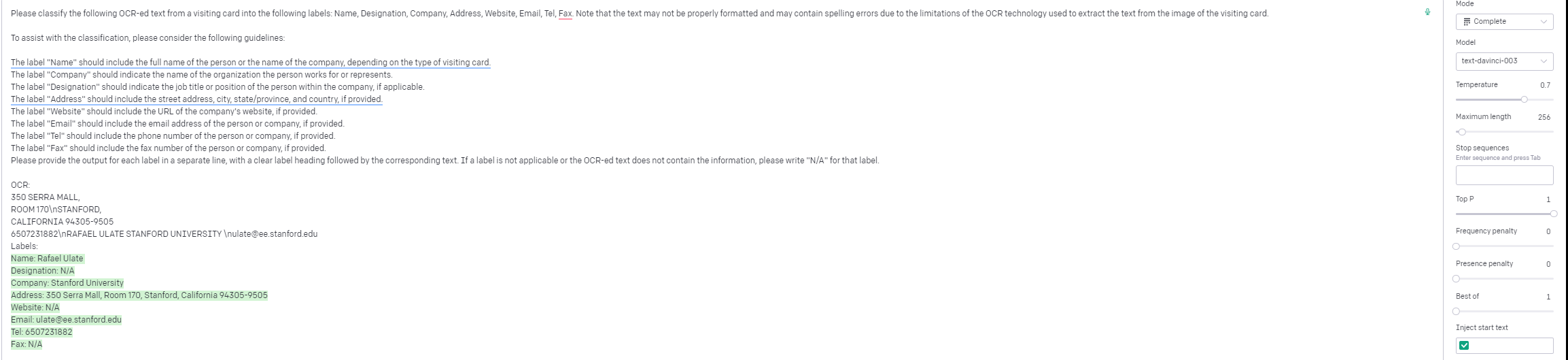
The above example shows our prompt with output hyperparameters in the OpenAI playground. We use langchain framework to hit the api and pseudolabel the dataset.
Results on Stanford Visual search dataset
Unlike the FUNSD datset, where the picture was very helpful in classifying classes, here the entities can just be classified with just the text and the visual placement might not have a significant effect. Taking a close look at the results, we find that tessaract sometimes misses @ or . and this leads to bert model missclassifying emails or websites, but end2end model fares better.

Comparison of F1 scores on the Stanford Visual Search Dataset by class
| Class | Non-end-to-end | End-to-end (layoutLM) | |
|---|---|---|---|
| Name | 0.89 | 0.93 | |
| Designation | 0.98 | 0.98 | |
| Address | 0.79 | 0.84 | |
| Website | 0.69 | 0.93 | |
| 0.72 | 0.91 | ||
| Overall | 0.81 | 0.92 |
Observation:
For most clasess ignoring the OCR mishap, we see that nonend2end models result is on par with end2end model. This can easily be attributed to the fact that structure in visiting cards dont matter as much as they matter in text documents or other document understanding task. This is also evident from the fact that large language models like GPT-3 can accurately pseudo label the dataset with just text and no strcuture information.
Qualitative comparison on RVL-CDIP classes
Unlike entity extraction which requires a text-based model for non-end2end model, this task can just be solved by a image model. But since this task still requires document understanding, we focus on understanding the qualititative embeddings of the two models.
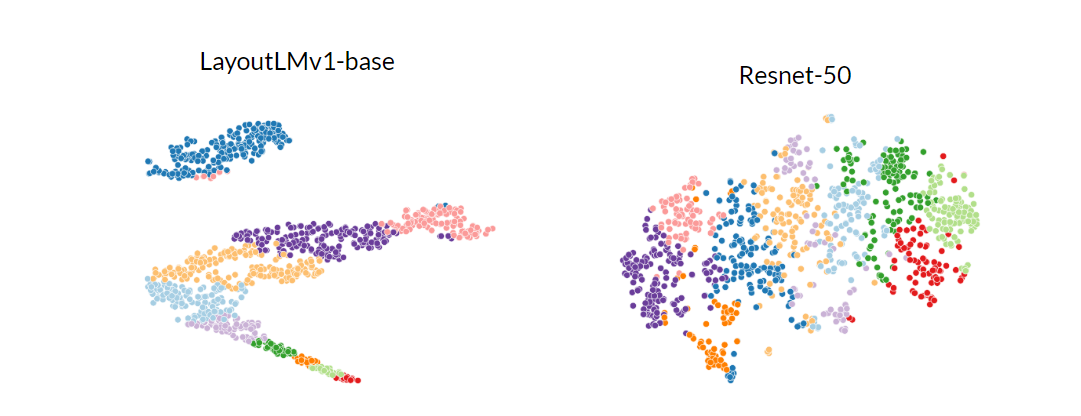
We mainly compare Resnet-50 and LayoutLM embeddings on the subset of this dataset after finetuning. We understand that the task is an unfair comparison as LayoutLM is also pretrained on some document understanding benchmarks and has a better initialization, but we still want to demonstrate how bad is the popular resnet embeddings for this task.
Task setting: We randomly sampled 100 examples from each class and plotted the TSNE projection of the embedding. For LayoutLM, we use the [CLS] token, while for resnet we get embedding from image2vec library of the finetuned checkpoint.
Observations:
We clearly see that LayoutLM embeddings show better class separation than resnet embeddings. This further illustrates why newer end2endmodel emdeddings are better initialization for most document understanding tasks than older pipeline based appraoches.
Conclusion and potential future work
-
From both quantitative and qualitative results, we see that using layout information and end2end training significantly outperforms pipeline based approaches For Non-end2end approaches, we find that most of the errors occur due to OCR engine (we use same ocr library for both approaches) but these errors are mitigated in end2end approaches which further integrate layout and image information end2end (Errors propagate in non-end2end approaches)
-
One potential drawback of end2end approaches is the vast amount of clean pretraining data (document text pairs and document classification datasets) needed to train the model. Ablating these resources and studying their cost comparing non-end2end approaches could be a good future work.
-
Our results strongly suggest end2endmodel pretraining appraoches are a much better initialization (quantitatively and qualitatively) across a low resource scenarios(funds, stanford visual search), tasks with denser text in images and large scale datasets (RVL-CDIP).
-
Most of our error analysis also indicate OCR component in both these model (tesseract) is a significant bottleneck but its errors are sort of mitigated due to structure in end2end models but propagated in non-end2end models. Hence, we believe that future work should focus on improving OCR engines or adopting OCR free approaches.
Recent works advocate for OCR free approaches and process image single shot and pass the representations to a pretrained language model decoder[6] which also has capabilities to do zero-shot reasoning (Question answering, mutli-step classification or more). We believe these systems are the future and more work leveraging the capabilites of LLMs to further improve image models or multimodal systems is the way forward.
References
[1] Devlin, J., Chang, M.-W., Lee, K., and Toutanova, K. Bert: Pre-training of deep bidirectional transformers for language understand- ing, 2019. [2] Dodds, E., Nguyen, H., Herdade, S., Culpepper, J., Kae, A., and Garrigues, P. Learning embeddings for product visual search with triplet loss and online sampling, 2018. [3] Driess, D., Xia, F., Sajjadi, M. S. M., Lynch, C., Chowdhery, A., Ichter, B., Wahid, A., Tompson, J., Vuong, Q., Yu, T., Huang, 6 W., Chebotar, Y., Sermanet, P., Duckworth, D., Levine, S., Van- houcke, V., Hausman, K., Toussaint, M., Greff, K., Zeng, A., Mordatch, I., and Florence, P. Palm-e: An embodied multimodal language model, 2023. [4] Guillaume Jaume, Hazim Kemal Ekenel, J.-P. T. Funsd: A dataset for form understanding in noisy scanned documents. In Accepted to ICDAR- OST (2019). [5] Le, Q. V., and Mikolov, T. Distributed representations of sentences and documents, 2014. [6] OpenAI. Gpt-4 technical report, 2023. [7] Pramanik, S., Mujumdar, S., and Patel, H. Towards a multi-modal, multi-task learning based pre-training framework for document representa- tion learning, 2022. [8] Tian, Z., Huang, W., He, T., He, P., and Qiao, Y. Detecting text in natural image with connectionist text proposal network, 2016. [9] Vaswani, A., Shazeer, N., Parmar, N., Uszkoreit, J., Jones, L., Gomez, A. N., Kaiser, L., and Polosukhin, I. Attention is all you need, 2017. [10] Wu, C., Yin, S., Qi, W., Wang, X., Tang, Z., and Duan, N. Visual chatgpt: Talking, drawing and editing with visual foundation models, 2023. [11] Xu, Y., Li, M., Cui, L., Huang, S., Wei, F., and Zhou, M. Lay- outLM: Pre-training of text and layout for document image understand- ing. In Proceedings of the 26th ACM SIGKDD International Conference on Knowledge Discovery & Data Mining (aug 2020), ACM.